🔒 Shared IP vs. Dedicated IP vs. Corporate Static IP: Pick the Right One and Keep Your AI Accounts Stable
As remote work and large language models become part of everyday workflows, developers, cross-border sellers, and overseas-facing teams keep running into the same decision when they set up an acceleration network: stick with a traditional shared IP, or move up to a dedicated IP or a corporate static IP?
A few years ago, the difference between these came down to little more than "faster or slower." But in 2026, with platforms like OpenAI, Anthropic, PayPal, and Stripe running far stricter risk-control checks, the IP type you choose increasingly decides how often you hit CAPTCHAs, "suspicious login" prompts, or limited access.
This guide breaks down the logic behind all three so you can weigh security against efficiency and pick the one that fits.
📊 At a Glance: Three IP Models Compared
| Dimension | 🌐 Shared IP (Shared) | 🎯 Dedicated IP (Dedicated) | 🏢 Corporate Static IP (Corporate Static) |
| Exclusivity |
🔴 Shared by many Hundreds to thousands on the same range |
🟢 Yours alone A private exit node for one operator |
🟢 Team Exclusive Reserved for your team’s company tunnel |
| Address Stability |
🔴 Drifts often Changes on reconnect or node reset |
🟢 Long-term fixed Stays absolutely consistent over time |
🟢 Long-term fixed Tied to a dedicated company line |
| Network Source | 🔴 Generic shared pool | 🟢 Clean IP from a local backbone data center | 👑 Clean commercial / ISP range |
| Risk-Control |
🔴 Lower (High Risk) Exposed to "collateral" flags & loops |
🟢 Higher Closer to a genuine local-user profile |
👑 Highest (Whitelist Trust) Trusted natively as a local business network |
| Bandwidth | 🔴 Contended at peak hours by other users | 🟢 Dedicated link, no noisy neighbors | 🟢 Business-grade priority, high concurrency |
| Best For | Light browsing, casual use, low-value traffic | Solo developers, premium AI accounts, individual sellers | Cross-border teams, e-commerce, high-value workflows |
🛑 1. Shared IP — The Liability in Traditional VPNs and Proxy Services
How it works: Hundreds, sometimes thousands, of users go out through the same server node. While you're writing code, someone else on that same IP might be hammering APIs or doing something the platform doesn't like.
-
⚠️ The Main Risk: Collateral Damage
Modern AI platforms like ChatGPT and Claude run fairly sophisticated risk-control engines. When a single IP suddenly sees a flood of requests from many different devices and fingerprints — or when one user on it trips an anti-abuse rule — the system may tighten controls across that whole IP range. That's one reason you can log in having "done nothing wrong" and still hit
Access Denied, repeated CAPTCHAs, or what feels like a quietly downgraded experience. -
⚠️ Fingerprint Jitter:
Because shared nodes balance load automatically, you might be on US-West node A one second and US-West node B the next. To payment platforms like Stripe and PayPal — or to high-value hosting platforms — that kind of rapid location shift looks like a possible account takeover, which can trigger extra verification or temporary restrictions.
🛡️ 2. Dedicated IP — A Stable Network Shield for the Solo Operator
How it works: TonboVPN sets aside a single clean, fixed IP from a local backbone data center, exclusively for you. For the duration of your lease, that node serves no one else.
-
👤 Closer to a Real Local-User Profile:
With TonboVPN's native TUN mode enabled on a dedicated IP, your network profile — as seen by the security checks at Google or Anthropic — looks much more like an engineer who actually lives and works in US-West or Europe: consistent behavior, a stable source.
-
🛡️ It Removes the Collateral-Damage Problem:
Because the IP is entirely yours, "noisy neighbors" are no longer a factor. Your premium AI accounts and Cursor agents can hold long, steady sessions, which sharply reduces the random CAPTCHA pop-ups and unfamiliar-login warnings that plague shared connections.
-
⚡ Clean, Dedicated Bandwidth:
With no one else competing on the same link, heavy-throughput work — high-volume image generation runs — routes quickly at Layer 3, keeping demanding tasks highly responsive.
👑 3. Corporate Static IP — Business-Grade Infrastructure for Teams
How it works: Built for companies, cross-border e-commerce operations, and high-value studios, this gives you a clean commercial IP range issued by an overseas ISP.
-
🤝 Asset Isolation and Team Collaboration:
A corporate static IP supports seamless multi-account access across a team. Whether it's a 20-person sales team or a cross-border engineering group, everyone's traffic exits through the same dedicated company tunnel the moment it leaves the OS — giving the whole team a unified, stable egress environment.
-
💎 Higher Network Reputation:
A commercial-grade network fingerprint is more readily trusted by overseas financial services, public clouds (AWS / GCP), and AI platforms, which means less added friction from verification checks. For high-value cross-border work — managing Amazon or Shopify operations, for instance — it provides a more stable network foundation and lowers the chance of disruptions caused by an unstable network environment.
🎯 Which One Should You Choose?
-
💡 Tight budget, occasional lookups: A Shared IP can work — just be ready for the occasional CAPTCHA or downgraded session.
-
💡 Solo developers, digital nomads, or anyone leaning hard on Cursor / ChatGPT: A Dedicated IP is usually the easier choice. It saves the hidden cost of switching nodes, editing configs, and appealing accounts, and hands that time back to your actual work.
-
💡 Multi-person cross-border teams, R&D centers, or businesses running high-value workflows: A Corporate Static IP keeps network-related uncertainty to a minimum.
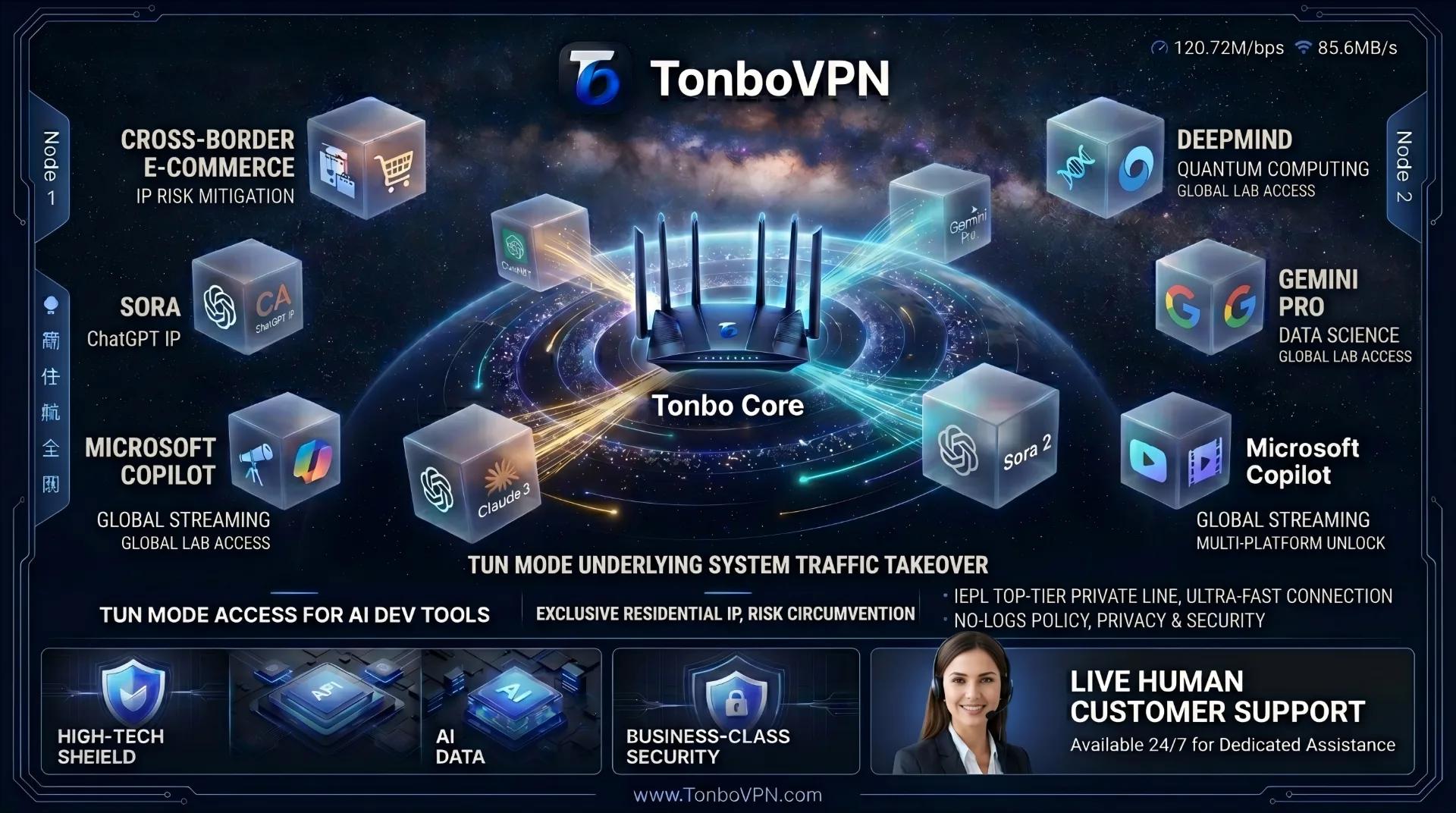
Not every acceleration tool controls the kernel, and not every IP is truly clean and exclusive. TonboVPN combines native TUN mode with physical IEPL lines to deliver a more stable, cleaner foundation for working across the global internet.
❓ FAQ
Q1: Will a dedicated IP completely eliminate CAPTCHAs and risk-control flags?
A: No tool can guarantee that. Your account also has to be used in line with each platform's terms. However, an exclusive, fixed IP removes the main trigger (collateral flagging) and provides a consistent network profile, which meaningfully lowers the odds of a false positive.
Q2: What's the biggest difference between a dedicated IP and a corporate static IP?
A: The dedicated IP is for individuals — one person, one clean node. The corporate static IP is for teams: a commercial ISP range with seamless multi-account access, higher bandwidth priority, and stronger network reputation.
Q3: Why the emphasis on TUN mode?
A: TUN mode handles traffic at the system network layer (Layer 3), so your apps and terminal all share the same exit. That avoids the fingerprint mismatch you get when some apps route through the proxy and others go direct, keeping your data sandbox tightly aligned.
👉 Visit the TonboVPN Website to set up the fixed network that fits you, and keep your AI workflow running smoothly.